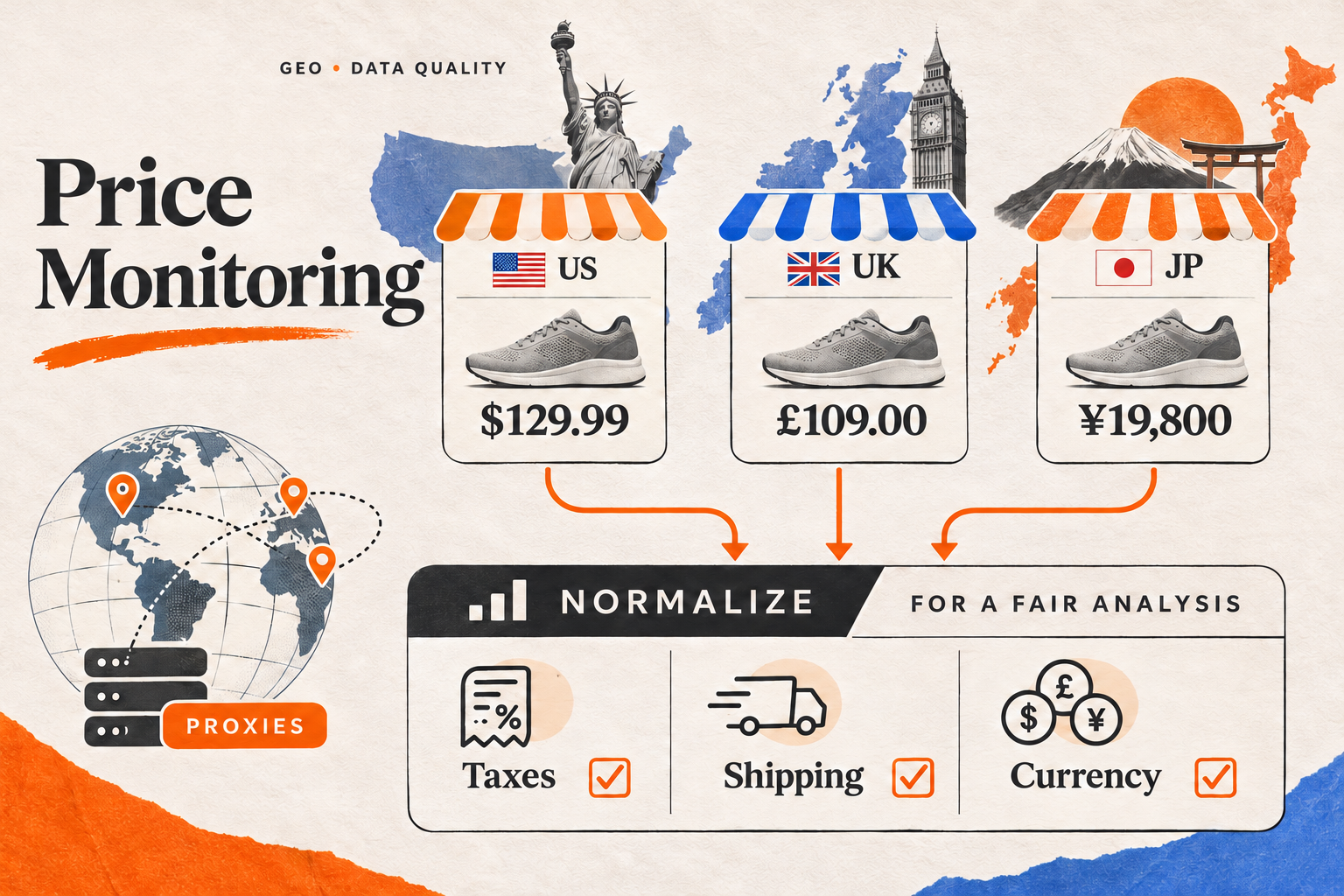
A proxy can show a retailer how a public product page appears from a selected region. It cannot, by itself, make two prices comparable. The same item may differ by variant, seller, stock, currency, tax treatment, delivery address, promotion, account state, and collection time. A useful price-monitoring system treats each observation as a structured record, then compares only records with a compatible definition.
This article is a workflow for authorized collection of public retail information. Check each source's access conditions and applicable rules, prefer an official feed or API when available, and avoid collecting personal account data merely to obtain a price.
First define the price you mean to monitor
A shelf price, a marketplace offer, and a delivered checkout total answer different questions. Decide whether the business decision needs the displayed item price, the lowest in-stock offer, or the total cost to a specified destination. Record the comparison definition before choosing an exit region or building a scraper. If shipping or tax is not visible, mark the total unknown; do not silently treat it as zero.
| Field | Why it matters | Validation rule |
|---|---|---|
| Exact product and variant | Size, color, pack count, model year and condition can change the offer. | Match a stable SKU/GTIN or a reviewed product mapping. |
| Seller and offer type | A marketplace listing may show multiple merchants or used items. | Record seller, condition and whether the offer is first-party. |
| Region and destination | Exit IP, locale and ship-to address can point to different markets. | Store observed exit and intended delivery market separately. |
| Currency and tax | Displayed prices can include or exclude tax; FX conversion has a time basis. | Keep original currency and tax state; record FX source and timestamp if converted. |
| Shipping, stock and promotion | A cheap but unavailable item or one-time coupon is not a like-for-like offer. | Use explicit unknown values and promotion flags. |
| Observation time and evidence | Prices and page layouts change. | Store UTC time, source URL and a permitted response snapshot or hash. |
Use location as one controlled variable
For a geographic comparison, start with one exact product and a short collection window. Keep browser language, account state, cookies, shipping address, device profile and parser version consistent where possible, while changing the exit region. Then repeat with the destination or locale changed deliberately to learn which signal actually changes the offer. A country-targeted proxy controls one input: the observed exit network. It does not override every localization signal.
A second pass should verify the observed exit IP and target page content. Seeing a different IP alone does not prove that the displayed price belongs to the intended market. Confirm currency, region selector, availability, and shipping destination on the returned page. If the product redirects to a different regional site, record the final URL rather than silently merging it with the original market.
Build a record that preserves uncertainty
The illustrative record below deliberately leaves shipping as `null`. It is a schema example, not a live price or an IP Fist endpoint. Currency amounts are strings to avoid binary floating-point errors. The `comparison_status` field prevents an incomplete observation from being used as a fully landed price.
{
  "product_id": "sku-123-color-blue-size-9",
  "seller": "example-store",
  "observed_at_utc": "2026-11-11T15:00:00Z",
  "exit_country": "GB",
  "ship_to_country": "GB",
  "currency": "GBP",
  "item_price": "109.00",
  "tax_included": true,
  "shipping_price": null,
  "availability": "in_stock",
  "promotion": null,
  "comparison_status": "shipping_unknown"
}
For analysis, group by exact product/variant, seller policy and destination market. Compare item price separately from landed cost. Only calculate landed cost when tax and shipping are known under the same assumptions. If converting currencies, store both the original amount and the exchange-rate source and timestamp so the historical comparison remains reproducible.
Measure data quality before scaling collection
| Metric | Definition | Action when it degrades |
|---|---|---|
| Valid observation rate | Share with the expected product, region, price, currency and stock fields. | Inspect selectors, redirects and page variants before adding traffic. |
| Comparable coverage | Share of target SKU × market cells with enough data for the chosen price definition. | Separate missing shipping/tax from missing product pages. |
| Freshness lag | Time between source observation and the decision that uses it. | Adjust the schedule for volatile categories; avoid duplicate polls. |
| Cost per valid observation | Proxy and collection cost divided by accepted records, not raw HTTP successes. | Reduce needless retries and reject invalid pages early. |
Start with a small approved SKU set, a few regions and a fixed schedule. A 200 response can contain a consent page, login screen or unrelated variant; validate the actual product fields. Treat 403, 429 and challenges as distinct outcomes and follow the source's rules rather than retrying aggressively. Preserve a parser version so a layout change does not masquerade as a price change.
Where IP Fist fits
IP Fist residential proxies describe rotating exits and geographic selection, and its pricing page distinguishes country-level and city-level plans. Choose the resolution required by the study, confirm it in your dashboard, and test the actual observed exit. For a repeatable region sample, use a stable session when the plan supports it; for broad coverage, rotation can help distribute independent observations. Neither mode fixes mismatched SKUs or missing shipping data. Review our rotating versus sticky session guide for the session trade-off.
Frequently asked questions
Does a proxy IP determine the final checkout price?
No. IP location may influence the page, but delivery address, tax rules, account state and promotions can still change checkout. Record the exact stage at which the price was observed.
Can I compare the lowest visible prices across countries?
Only after matching the same variant, seller/condition rules, stock state and price basis. Keep the original currency and explicitly document the FX rate and missing charges.
Which matters more: proxy success rate or price data quality?
A successful connection is a prerequisite, but business decisions depend on valid, comparable observations. Track cost per valid record and comparable coverage alongside network outcomes.
Sources and scope
The market use case was reviewed against Oxylabs' price-monitoring overview and Bright Data's location-pricing explainer. IP Fist product details follow its residential page and plan details. The observation schema and quality framework are editorial recommendations, not measured IP Fist performance claims.